 DRIPOLOGYPRESCRIPTION • RX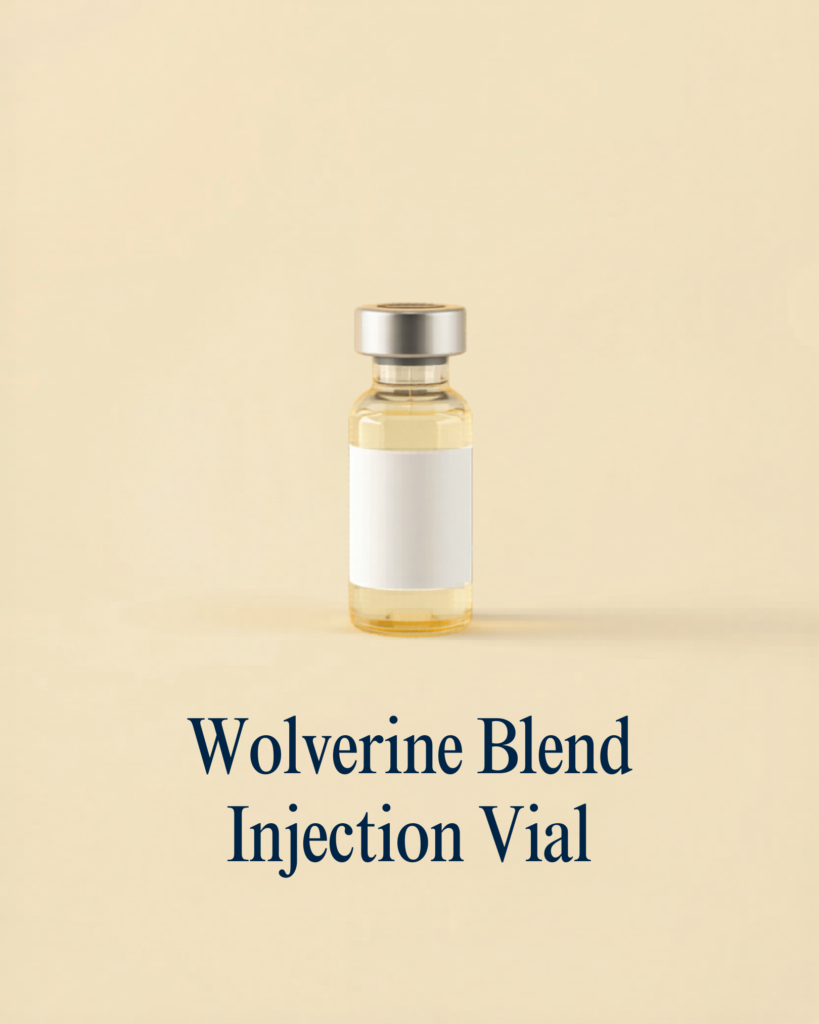
Wolverine Blend
Signature recovery blend.
Subscription. Cancel any time.
- 5-minute intake form
- No labs required
- State-licensed prescriber
- U.S.-licensed compounding pharmacy
- Discreet nationwide shipping
- Direct provider messaging
- 15% off with auto-refill
No charge unless approved & you choose to fill.
What it is
The Wolverine Blend is a recovery-focused stack that combines three peptides studied in research contexts for tissue repair: BPC-157, TB-500 (a synthetic fragment of thymosin β-4), and GHK-Cu (a naturally occurring copper tripeptide). It is compounded by a licensed compounding pharmacy and dispensed only after a state-licensed prescriber reviews your intake — formulated for adults focused on soft-tissue recovery, training load, and post-injury or post-procedure healing support.
What’s inside
Three peptides, three complementary repair pathways:
- BPC-157 — “Body Protection Compound,” a synthetic peptide based on a sequence found in gastric juice. Studied in preclinical models for tendon, ligament, muscle, and gut-lining repair through growth-factor signaling and new blood-vessel formation (angiogenesis).
- TB-500 — a synthetic fragment of thymosin β-4. In research models it binds actin to help mobilize the repair cells (fibroblasts, endothelial cells, keratinocytes) that migrate to injured tissue, and it raises VEGF to support angiogenesis.
- GHK-Cu — a copper-binding tripeptide naturally present in the body that declines with age. Studied for its role in collagen and elastin synthesis, inflammation, and connective-tissue remodeling.
How it works
Each peptide has been studied for a different part of the repair process — BPC-157 for growth-factor signaling, TB-500 for repair-cell migration and blood-vessel formation, and GHK-Cu for collagen synthesis and tissue remodeling — which is the rationale for combining them rather than using one alone. Most supporting evidence is preclinical (laboratory and animal studies); robust human clinical trials are limited.
What to expect
Peptide protocols are generally run in cycles over several weeks. Any response develops gradually and varies from person to person — some people may notice little or no change. Your prescriber sets the protocol, dose, and timeline based on your goals and history. The component peptides are research peptides, are not FDA-approved, and no specific result is promised or guaranteed. Because BPC-157 and TB-500 appear on the WADA prohibited list, the blend is not suitable during sanctioned athletic competition.
Who your provider may consider it for
Your licensed telehealth prescriber may consider the Wolverine Blend in research-context protocols for adults with tissue-repair goals after reviewing your intake and history.
What your provider will discuss with you
- Specific tissue-repair or recovery goals
- Cancer history (relevant consideration for peptides affecting angiogenesis)
- Concurrent peptides, supplements, or therapies
- Injection technique and protocol
- Athletic competition status (some peptides appear on WADA prohibited lists)
Common questions
Is the Wolverine Blend FDA-approved?
No. The component peptides are research peptides and are not FDA-approved for any use, and compounded medications are not FDA-approved as finished drugs. The blend is dispensed only after a state-licensed prescriber reviews your intake.
How is it taken?
Peptide blends are typically given as a small subcutaneous (under-the-skin) injection. The pharmacy supplies the exact preparation, and your provider reviews technique with you.
How long is a cycle?
Protocols are generally run in cycles over several weeks, often with breaks in between. There is no single standard schedule — your prescriber sets the dose and duration based on your goals and history.
Can I take it alongside my other treatments?
Possibly, but only your prescriber can assess interactions. List everything you take — including GLP-1 medications, hormones, and supplements — during intake.
Could it affect drug testing?
Some component peptides (such as BPC-157 and TB-500) appear on the WADA prohibited list. If you are subject to anti-doping testing or sanctioned competition, this blend is not suitable — let your provider know.
What does the research look like?
Most supporting evidence is preclinical (laboratory and animal studies); human clinical evidence is limited. These pages describe what the peptides have been studied for, not promised results.
Who should not use it?
It is not for anyone under 18, pregnant, or breastfeeding. Your prescriber will also review your history — including any cancer history, which is relevant for peptides that influence cell growth or blood-vessel formation.
Considerations
Each component peptide has a limited human clinical evidence base. Combinations have not been individually studied in robust clinical trials. Your prescriber will discuss current evidence.
Regulatory note. Component peptides are research peptides and are not FDA-approved. Availability of each component is subject to FDA bulk-substance status; your prescriber will confirm what can be compounded at the time of consultation.
Federal regulations (FDA compounding regulations) and state medical board rules govern what your licensed telehealth prescriber can lawfully prescribe to you. See our full regulatory disclosure for active state and federal regulations affecting availability.
Visiting LA or NYC? Looking for IV therapy or in-clinic treatments? Visit dripology.co.
Five minutes to start your free consultation.
Free consultation. No charge unless approved.
Prefer to come in?
Dripology operates two flagship clinics — Santa Monica and New York City. IV therapy, aesthetics, in-clinic peptide protocols, and provider-led concierge care.